So we have at least 3, possibly 6 Sparrowhawks in UCD this Summer.
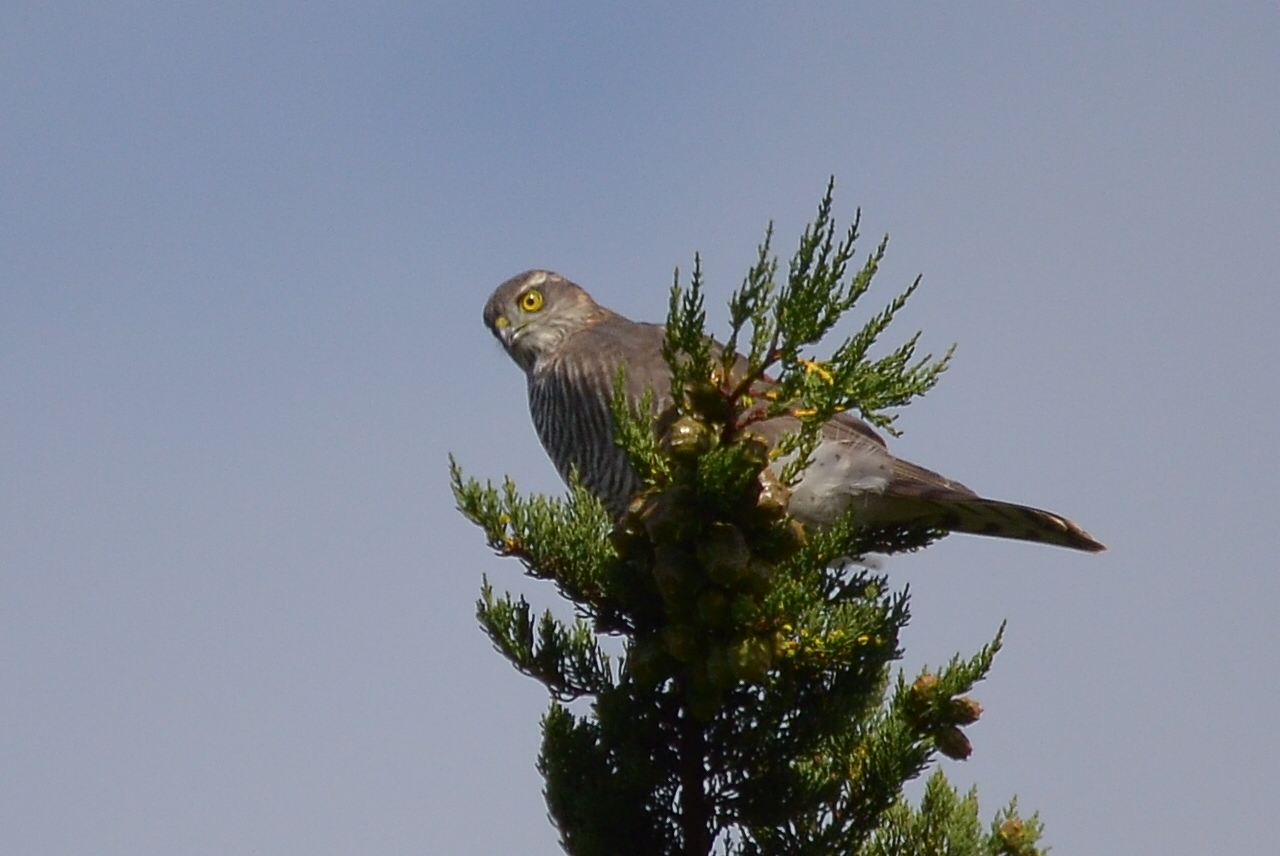
From never having really seen one, I spent quite a bit of time watching one of the Sparrowhawk juveniles for well over an hour on Saturday.
It spent a lot of time at the top of a tree just sitting around, preening and being silent. I spent a lot of time under the tree just sitting around, preening and being silent. It was a cool shared experience. I was surprised it was on its own after hearing all the raucous calling during the week, but seeing one was better than none.
Juvenile Sparrowhawk, UCD - July 28 2012
Sparrowhawk, UCD. Supercilium over the eye, together with brownish plumage means this is a juvenile. A supercilium with grey plumage would be an adult female, and no supercilium with rufous cheek and breast would be an adult male.
This juvenile is independently hunting already.
After hanging out watching the Sparrowhawk, I wandered over to the main lake to see if I could manage a photo of the Tufted duck chicks.
Tufted Duck chick, 3ish weeks old, main lake, UCD, July 28 2012.
Tufted duck chick, main lake,UCD
Tufted duck chick, UCD main lake.
Mother Tufted looks on.
One of two adult Herring gulls always around the main UCD lake.
If you had this looking at you whilst eating your sarnie at the lake, wouldn't you throw it some crumbs? With that glare I'd offer my whole lunch.
The Black headed gull numbers were up to 55 by the main lake.
All of them in different stages of summer/ winter plumage.
I never remember if they grow white head feathers for winter, or lose their black head feathers from summer.
They lose their black head feathers from summer.
I just looked it up.
Black headed gull with its summer breeding plumage.
A little scratch
And all the brown feathers have fallen out. Black headed gull moulting into winter plumage.
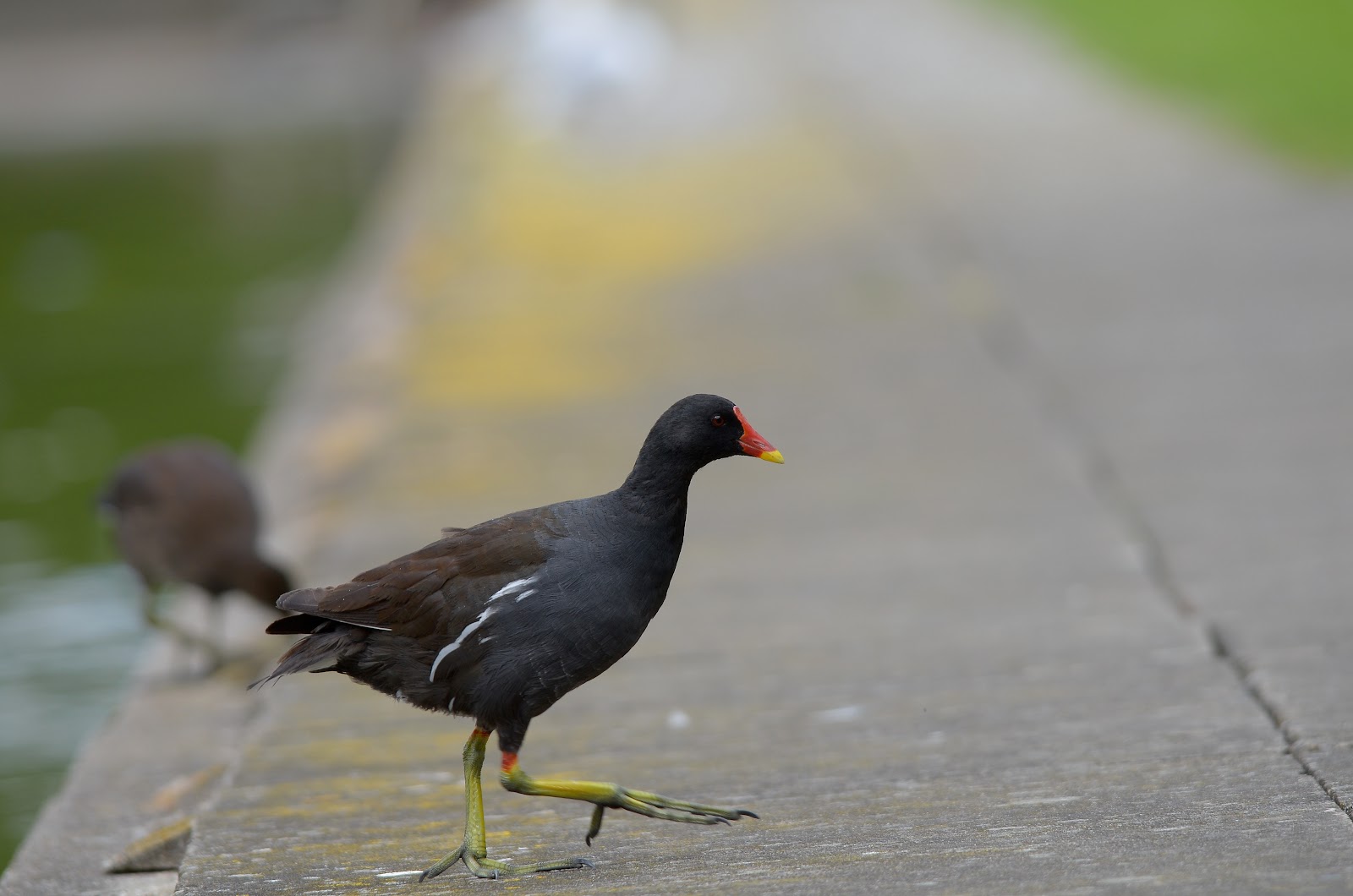
Moorhen chick, main lake UCD. I think about 3 months old, born on the island in the main lake.
Yes, well done you Papa Moorhen.
For a good few months I noticed Jackdaws hanging out on this ledge, usually with loads of students milling around underneath. This area is one of the busiest student areas in UCD, but oblivious, the Jackdaws started to build this nest. I didn't think it would last without falling, but chicks emerged and they can now be seen around the Main lake. Quite a success story.
Juvenile Jackdaw, UCD - Some mothers do ave em.
I know it could be considered a bit sad going into your workplace on a weekend, but that doesn't dawn on me. I wanted to see the Sparrowhawks properly and see what they were at and I managed to see them really well and even manged some photos.
Difficult to do that properly when you're on a lunch break.
Tufted ducks are breeding in UCD!! For the first time today I noticed two Tufted duck chicks swimming and diving in the Main lake.
Tufted ducks do breed in Ireland, but it's so not common around Dublin, so to see some Tufted duck chicks on the Main lake was a bit of a thrill.
Image quality not great, taken with my iphone.
This shows the little chick taking a good old jump in the air before diving, there's also a glimpse of the Mute swan cygnets who are now nearly 4 months old, Moorhen chicks and the Mallard chicks now considerably larger. You'll notice too that all of the Mallards are in eclipse.
A glimpse of the 4 cygnets on UCD main lake, now at 4 months old.
You can hear 3 Sparrowhawks calling in the ucd woods. I caught a glimpse of one of them.
Different UCD woods, 3 Sparrowhawks calling again (plus jogger jogging by and a few walkers). I'm guessing the same Sparrowhawks flew over to these woods as I arrived, but I didn't take that long to walk over to these other woods and I wouldn't be surprised if there are 2 Sparrowhawk families in the UCD grounds, it depends how far territories have to be from each other, and that I don't know. At some points the calls nearly sound like gulls, but I caught glimpses and saw 2 of the Sparrowhawks having a tumble with each other.
Disappointed by the Yes vote?!
This might cheer you up.
For a millisecond.
8 Mallard chicks, 3 Moorhen chicks and 4 cygnets, plus parents - are now all living on the little island on the main UCD Lake!
Austerity means nada to these little things, we throw them a bit of Brennans, bit of lettuce and they're happy out.
I first noticed the 8 bundles of Mallard joy yesterday, I'm pretty sure it was their first outing.
They were out again today, snoozing, sunning themselves, so this vid is a bit boring, but I wanted a record of the 8 of them on the lake.
As you can see in the background there are still 4 cygnets left from the original 6 cygnets born on the lake.
They've grown loads in 4 weeks and the moult into white feathers is already showing.
A reminder of how small they were
Also, adding to the mix of chick species on the island, 3 little Moorhen chicks have been strutting their scrawny little legs around the edge. I haven't seen them take to the water yet, unlike the ones down near the secret lakes who are bombing it around the joint.
Hope these little bundles of joy cheered you up a little bit?
Teeny, tiny bit?
Bit of Brennans, bit of lettuce - we'll all be fine.
**Question.
The adult mallard looking after the little chicks on the ucd lake looks to me to be a male? This is highly unusual as I've only ever seen the female adult looking after the chicks.
If you look, the adult appears to have male eclipse plumage, you can see the green sheen on the head feathers (if you can't see the sheen in the video, trust me there's a definite green sheen), the white patch on the chest and the colouring matches a male far more than a female, plus there's the lack of the male duck curl on the tail feathers? If anyone could throw any light on this I'd be interested.
Also btw, fyi, ftr, this footage and the footage of the cygnets in yesterday's post was shot with a teeny, tiny handheld point and shoot camera (an ixus 220), from a distance where Ifigured I wasn't causing any distress to the swans or the cygnets.
The camera has a decent zoom for a little camera and can go in quite close without physically being close.
I also crouched down for a while before I got my camera out, just so the swans got used to me and knew I was no harm, when someone else started feeding the swans I started to film.
I'm just putting this info out there because I'm very aware of the distress people can cause to birds by getting too close for photos/ footage etc and hopefully me writing this might remind others that the bird's comfort and safety always comes before your photo/ footage.
So the UCD Mute swans have done it again, successfully brought another 6 cygnets into the world.
Exactly the same number of cygnets as last year and bang on the Mute Swan average clutch size of 6.
Last year's cygnets made their first appearance on the 4th of May, this year it was the 30th of April.
From what I can gather the timeline for the UCD swans was as follows:
It was mid February when the Mute swans started buidling their nest on the little island in the ucd lake.
The male adult swan swam around gathering appropriate twigs and handed them to the female adult who arranged them into a nest, this continued for a few weeks.
At the start of March, Mrs sat in her nest and started laying 6-8 eggs. Mute swans usually lay an egg every other day, so that's approx 12- 16 days laying eggs, which takes us to mid March.
#Occupynest begins.
Incubation can take a month to 6 weeks, in this case incubation must have been 6 weeks if the cygnets hatched and were on the lake by April 30th (cygnets will all take to the water 24 hours after the last cygnet has hatched).
During the incubation period the female adult will get up every now and then, stretch her legs, do her yoga exercises and feed. Whilst she's off the nest, the male will take over incubating, but this isn't ever for too long as it's the female who does most of the incubating.
Once the last cygnet has hatched, they all stay in the warmth for another day, getting their hair and make up done to perfection - ready for Showtime.
April 30th 2012, and it's Showtime day. The 6 cygnets leave the nest and can be found floating around the ucd lake, following Ma and Pa everywhere, Wowing everyone who lays eyes on them..
They look completely clueless, but they know how to soften us humans and make us smile - just check out their showstopper routine - getting a lift around the lake on their parent's back!
Oh, they've got us sussed - they've got us feeding them haven't they.
Adult swans don't feed the their cygnets beak to beak, instead you'll see the parents tipping up and reaching down to the bottom of the lake to dislodge food for the chizlers.
Here's hoping the ucd cygnets enjoy eating dirty empty crisp packets, dirty bits of newspaper and all the other rubbish I saw the female adult dislodging from the bottom of the lake yesterday.
Luckily in ucd there's lots of the students and kind visitors who feed them bread and this is great for the Swans, as are salad leaves and Mute swans love lettuce!
As long as the bread is thrown into the water (so it softens, making it more digestible), and isn't mouldy (swans will get sick on mouldy bread), bread is fine to feed to swans, preferably decent grainy bread.
So there you go, unless the cygnets are eaten by a hungry Hooded crow, Rook, Magpie, Heron or fox (all around ucd), they should be styling their 'aren't I so damn gorgeous' look on the lake until late August/ early September.
Once September comes, the cygnets will have moulted their baby feathers and will look more like adults, and in bird circles, if you look like an adult, you're going to be treated like an adult.
Once doting parents, will suddenly see their children as potential threats to territory and start aggressively tormenting them away.
Freaked out, the juveniles will fly over to somewhere like the Grand canal, where they'll happily live in a flock for a few years until it's time for them to start the breeding cycle themselves.
And so cycle continues, year after year.
I've seen lots of fledglings from several species around ucd, Blackbird, Magpie, Blue tit, Wood pigeon, I think Dunnock or Robin.
I love watching their unadult like behaviour.
I watched a baby Magpie jumping from branch to branch yesterday shouting inaudible 'Waheys' between each jump, shaking herself, checking the feathers were all her own.
A baby Blackbird which was sitting in a tree, instead of flying away as I approached, jumped into a flower container on the ground.
A couple of baby Blue tits behind the creche looked comical in their brand new feathers, erratically flying from one shrub to another, landing by pure luck rathen that design.
Walking around ucd at the moment is pure joy.
Also so first ucd Swallow yesterday and a Swift flying over the Dodder river near Clonskeagh gate.
Feb 14th - Happy Valiers and Hello Mandarin Ducks!! on the ucd main lake. 40. Mandarin Duck.
Des saw 2 Mandarins swimming out in the middle of the lake !! Typically I chose this lunchtime to work through, but when I saw his email, I looked at my work, thought sod that and pulled on my jacket.
Didn't see any Mandarins swimming around in the open by the time I got over, but a closer look on the little island where the swans always nest gave a glimpse of a male mandarin's head!
Rang Niall and Ciaran.
I know that Mandarins are 'just' escapees and domestic and sniffed at by serious birders - but still, there was something different on the lake! A brand new species and a beautifully plumaged species at that, and once Mandarins arrive in places they do seem to stay without doing any other birds any harm (Phoenix park, the Basin.. other places I can't think of).
So this could be the start of Mandarin Ducks on the main lake in ucd and that'd be quite cool ...
Went down to the lake later during a break in the afternoon, luckily there was a couple feeding bread to the ducks which seemed to be attracting the Mandarins too, so I was able to see the male and female Mandarin out in the open and get some footage with my ipod.
I've seen Mandarins a few times before, first time was in Berlin and the second time was in Phoenix park. Both these times I've noticed how they don't usually eat the bread people threw to them, whereas today the male was diving right in there.
As for the Mute Swans being symbols of love and gentleness and together forever ....
It may be Valentines but as you can see from the footage, there's no love lost between the Mute Swans and the Mandarins, especially the female Mandarin.
That's what you get when you try to move in on a Mute Swan's nesting territory.
I've only just noticed that I should have turned my ipod sideways to video, this footage looks crap, but you get the idea.
Start of footage shows Mute Swans defending territory against the female Mandarin, the male Mandarin gets a bit of a chase, but nothing compared to the continual chase of the female.
Exactly a year ago today (19 Jan) I spotted a Water rail in UCD down by the 'secret lakes', it was a great find but was to be my only sighting of it over the whole year.
This winter I reguarly scanned the area again, before and after Christmas, but together with no Redwing nor Teal, I assumed lack of Water rail was in keeping with the mild winter non-arrivals.
Until Tuesday, when Niall and Billy got in touch to say there was a report on Irish Birding by Des Higgins of a Water rail in UCD - in exactly the same location as last year!
I headed down on Tues and sure enough saw it darting along the vegetataion, then it came out into the open and showed off its distinctive plumage good n' proper. It's a striking package for a little bird.
Its location is right next to a path well used by joggers, walkers and dog walkers, so the views were quite out in the open but fleeting due to disturbance and its nature. Soon enough Billy ambled along and I was able to show him where the Water rail was, he had his camera and managed a few decent shots.
Today I brought my lens into work and headed down during lunch - please be there, please be there.
I had the place to myself and not a single jogger/ walker went by, so it was silent except for bird song and the Water rail.
Water rail, UCD, Dublin
Water rail, UCD, Dublin, Jan 19th 2012
Water rail started singing/ alarm call?
Once I saw the Water rail starting to throw shapes and sounds around the place, a little ding sound went off in my brain and I started to record.
So, aswell as a still image I also present you with 30 seconds of a Calling Water rail in UCD:
Apologies for the shakiness, the (heavy) lens was handheld and there was nowhere to rest the lens and when you're videoing you've got to hold the camera out in front to look at the monitor blah, blah, excuses, blah.
Anyhow - pretty cool to have a Water rail out in the open, to hear it calling was a bonus.
You can see at the start of the footage its looking around in every direction, but from 30 secs on it fixes me with the filthiest look I think I've ever been given. I'm assuming it's throwing evils at me anyway, could have been something else.
After the Water rail had disappeared back into the vegetation, I decided to leave it alone and wandered off to see what else was around.
It was quietish today, but still there were some nice sightings.
Blue tit, UCD, Dublin - my favourite punk bird.
Long tailed tit, UCD, Dublin, Jan 2012
Robin, UCD, Dublin, Jan 2012
Mistle Thrush showing white feathers from underwing, UCD, Dublin, Jan 2012
Silvery, 'cold brown' back of a Mistle Thrush, UCD, Dublin, Jan 2012
Tough Tufted Duck gang, UCD Main Lakes - Jan 2012
Moor hen with very red legs, Main lake, UCD (Niall has said the amount of red in the legs is due to this bird being pumped with loads of testostrone coming into breeding season)
Oiks, Footie pitches next to Chapel - UCD, Jan 2012
Oyster catchers, UCD - Jan 2012
Lots of grey squirrels around campus, this one was eating a thrown away apple core. UCD - Jan 2012
Typically the influx of 200 BH Gulls (+ the 2nd yr Med Gull) was nowhere to be seen the next day when I had my camera with me.
I got these few shots anyway, early in the morning, well 8.30am.
Jackdaw, fields in front of Roebuck, UCD
Mistle Thrush on wood chippings infront of Roebuck fields, UCD, there were a couple of them.
Family of Greenfinches, Roebuck fields, UCD
I like this photo - Greenfinch with flash of yellow from a Goldfinch in flight, UCD (you can tell it's a Goldfinch from the white rump).
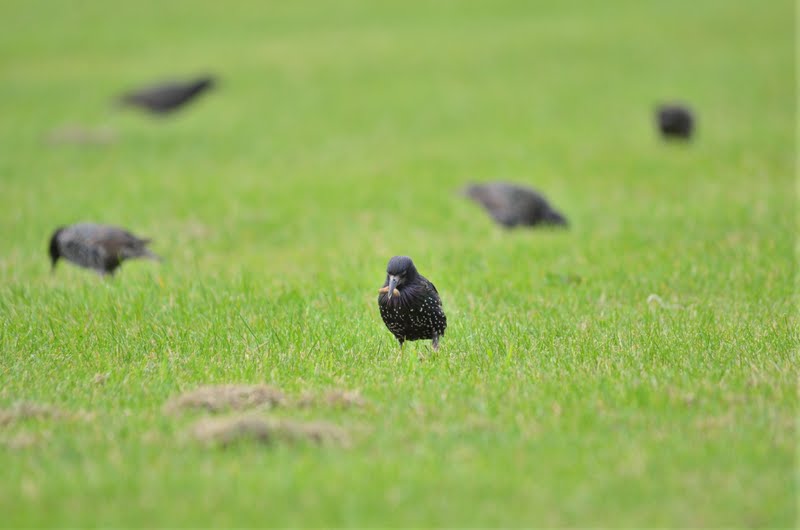
Flock of Starlings feeding on fields in front of Roebuck
As well as getting to work early to see the Med Gull again, I was also hoping to see the Curlew, but I didn't manage either.
Still a nice start to the day to see these birds though, especially the close ups of the Mistle Thrushes.
Influx of Black headed gulls in ucd today.
I'm guessing 200+ on the footie fields as I drove in at 8.50am.
By lunchtime they had dispersed into various pockets all over campus, I kept my eyes peeled for the 99.9% adult med gull I saw last week, but couldn't spot it.
What I did see though, walking around with 30 ish other BH gulls was a 2nd summer moulting into 2nd winter plumage Med Gull.
Try telling someone that quickly!
I heard a Curlew in ucd!
One morning a couple of weeks ago, as I walked from the car park into work, I heard a Curlew call from over near the Quinn building, it was lovely to hear, I've never seen one on campus, but imagined I might.
Usually, if work was in its normal swing of things, I'd have gone for a walk at lunch to try and locate it, but in the last few weeks I've been so snowed under with work, I've hardly had time to eat lunch, let alone step outside the building for 10 minutes... so the Curlew I think, has been and gone.
Thankfully, work should level out over the next few weeks and I'll be able to take lunch breaks again.. like I did yesterday.
Grey Heron (not a common sight in ucd), it better not get too comfy on that perch, water usually shoots up out of that pipe. And look! There's some actual sunshine lighting up the picture for a fraction of a second.
Female mallard, NKOTB having a stretch and Moorhen in background.
Lazy but clever juv Jackdaw begging for lunch.
Juvenile Tufted Duck with white feathers growing through on side. There's lots of juv Tufties, Mallards, Moorhens, Swans and now a juv Grey Heron on the ucd lake. And rain.
Black Headed Gulls, lots on the lake.
Always with the sqauwking
and the shouting
and the arguing.
Female Mallard chick, much quieter resident.
Moorhen, taking a walk on the wild side, ucd lake
There are loads of Wood pigeons around UCD, some mornings when I pass the playing fields on my way into work there's easily 40 or 50 on the football fields. Lots of BH Gulls too. One morning last week, I'm 99.9% sure I saw a Med gull in with the Black Headed Gulls.
2 Dunnocks, Chasing pavements.
Dunnock, ucd.
I cracked the face of my flippin ipod (which was in my back pocket) sitting back on my heel taking this shot... new ipod out in august though apparently..
Swallow, ucd fields
Swallow, ucd fields
House Martin (you can see the white rump), ucd fields
So there's some of what's happening around UCD.
Big news is hearing the Curlew and the 99.9% sighting of the Med Gull.
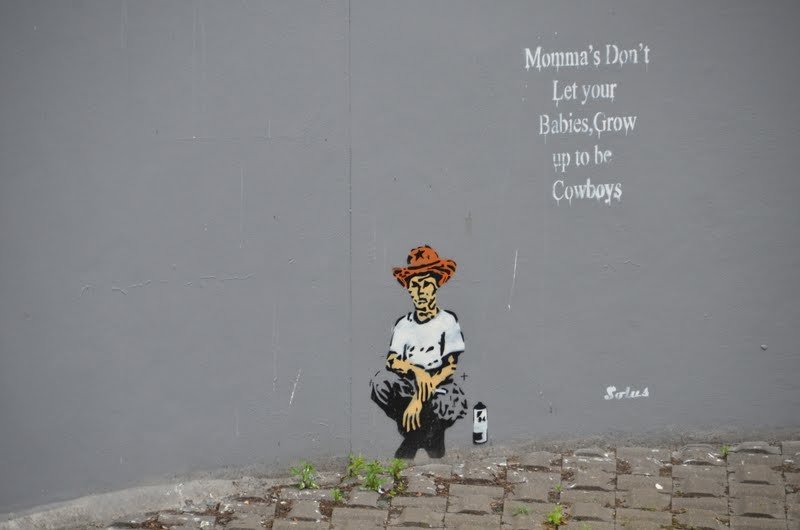
On my way home, since I had my camera with me I parked up and took a shot of this painting I've been passing for months now.
Street Art under Harolds Cross Bridge, along the grand canal, Dublin
'Mommas don't let your babies grow up to be Cowboys' by Solus July 2011 (it's been there a few months).